Agriates Desert
Agriates Desert
Wild beaches, dense maquis and Genoese towers: complete guide to the Agriates Desert, between Saint-Florent and the Ostriconi, in northern Corse.
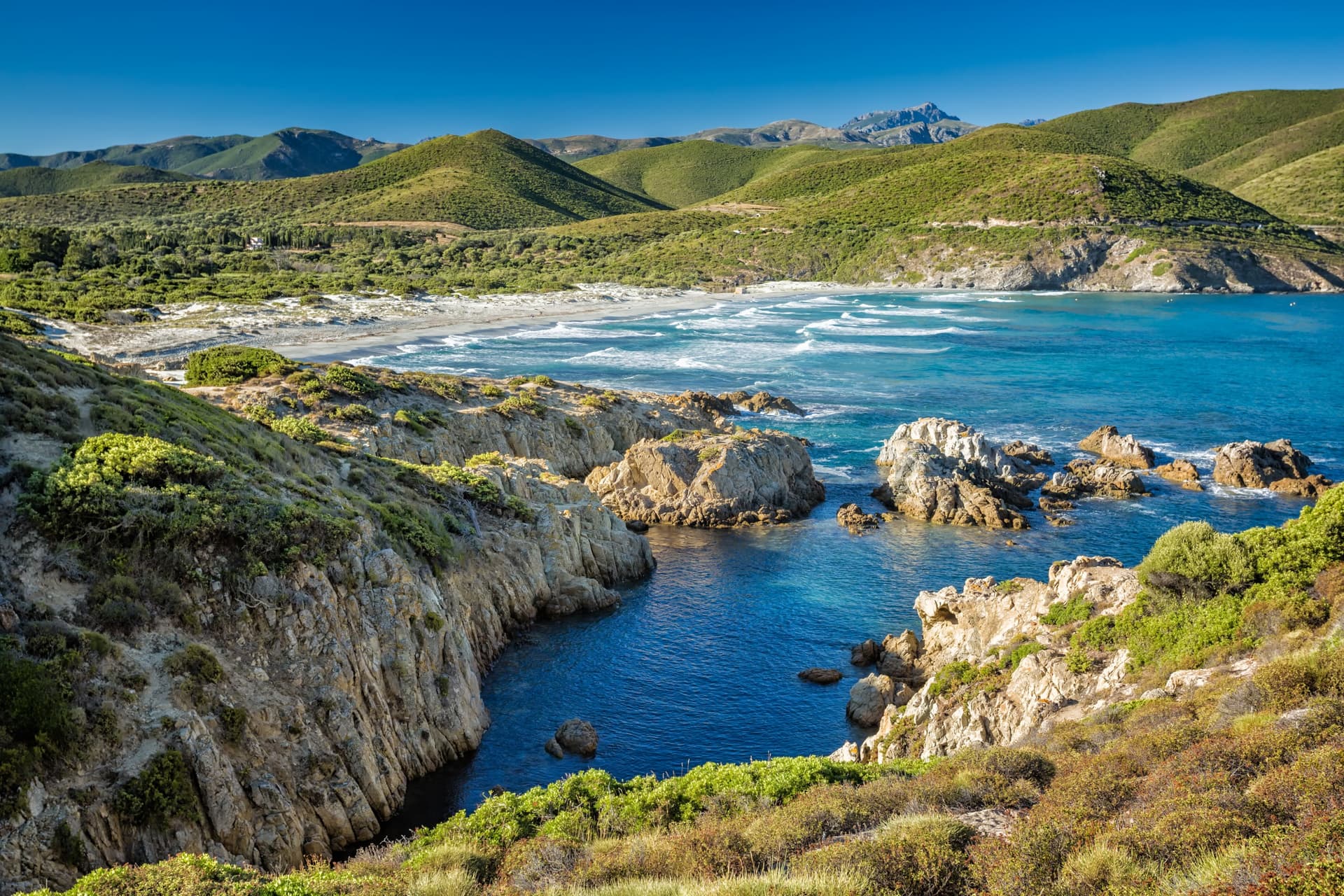
« A desert where nature reigns supreme »—this is how this Corsican gem defines itself. Indeed, the somewhat scattered landscape of the Agriates Desert intrigues the most curious travelers. Its rocky escarpments and chalk mountains are beautifully contrasted by its paradisiacal beaches and breathtaking Mediterranean vegetation. Tourists flock here mainly to enjoy its beaches, which are reputed to be among the most beautiful in all of Upper Corse and the island of beauty. The Agriates Desert is a destination to be discovered in countless ways: by boat, kayak, 4x4, bicycle, on foot, and more.
The Agriates Desert in a nutshell
Shared between the micro-regions of Balagne to the west and Nebbio, the Agriates Desert is a small desert spanning 40 km in the northeast of the island of Corse. It covers a total area of 15,000 hectares between sea and mountain. It is surrounded by:
- To the east by the gulf and the village of Saint-Florent
- To the west by the Ostriconi Valley and to the northwest by Cape Corse
- To the north by unspoiled coastlines, the Mediterranean Sea and Île-Rousse
- To the south by the mountainous massif of Serra di Tenda
Its mountainous, coastal, and wild environment is truly conducive to tourism. Hiking trails, dream beaches, boat excursions, and many other tourist activities await you.
A bit of history
The name "Agriates Desert" refers more to the region's history than to its soil characteristics. The lands were once cultivated and long sustained the local population, earning it the nickname "Corsica's granary." When Arabs invaded the island, they drove farmers from the region, pushing them into the surrounding mountains. Consequently, the lands gradually returned to their wild state and became desert-like.
Despite the Mediterranean vegetation, the place remains a desert with no settlements or agriculture, except for a shepherd's hut (called pagliaghji or thatch shelters) and a herd of cattle grazing peacefully in the scrubland. The only inhabited village in the region is Casta.
Since 1979, the Coastal Conservancy has acquired 5,500 hectares, representing 35 km of coastline forming the protected natural site of the Agriates.
Today
Now a protected natural area, the Agriates Desert gained fame in tourism thanks to its numerous beautiful beaches, particularly Saleccia. More of a wild peninsula than a true desert, this destination is also where rocky ridges meet valleys covered in dense Mediterranean maquis. The Mediterranean vegetation
The beaches with crystalline waters and white sand, the chalk-colored mountains, the lush Mediterranean vegetation… It is this beautiful blend created by Mother Nature that gives the Agriates Desert its tourist appeal. This is truly a must-visit destination for discovering the island of beauty.
Fauna and flora
Beyond the wild landscape adorned with mountains and beaches, the Agriates Desert is also enhanced by Mediterranean plants and trees such as heather, shrubs, cistus, myrtle, olive, oak, and maritime pine. Agricultural plains, copses, and meadows provide refuge for wildlife. The protected natural site of the Agriates, managed by the Coastal Conservancy, also welcomes numerous species of birds and butterflies and rare plants.
What to see in the Agriates Desert?
Architectural heritage
Mortella Tower is the only existing tower along the entire Agriates coastline. Built on the initiative of Admiral Andrea Doria in 1553 and fortified in 1554 during the Corsican Wars, this tower, listed as a historic monument, is well worth a visit, as is the Ostriconi Tower, which served to defend the Agriates and Saint-Florent. This second tower was built by the Genoese in the 16th century.
Monte-Revincu Dolmens
Located in the middle of the Casta-nord military terrain and shooting range, the two dolmens of Monte-Revincu are classified as historic monuments since 1889, making them a must-see.
Hiking trails
The Customs Officer Trail (or coastal path) is highly recommended when visiting the Agriates Desert, especially for hikers. The wild and inhospitable landscape is perfect for a change of scenery. This very long trail connects Saint-Florent to Ostriconi passing through Ghignu and Saleccia. To give you an idea of the hike, it takes approximately 5.5 hours of walking from Saint-Florent to Saleccia on foot. Pack light but sturdy hiking shoes and plenty of water. Don't forget a hat, sunscreen, and sunglasses. You can rest in the shelters (the Ghignu refuges) set up at Alga Putrica and at Saleccia campground.
The hike from Lotu beach to Saleccia beach is much shorter (around 1 hour) and easier. The view of the blue nuances of the beaches is very rewarding after your walk.
Mountain biking
Cycling is also an excellent way to explore the Agriates Desert. You can travel the coastal trail with the necessary equipment for this activity: mountain bike, hat, water, etc. However, it's advisable to be accompanied by a guide to best learn the surroundings.
4×4 excursions
This option is suitable for family trips, as long hiking and cycling trails may not be ideal for children. Once you reach the beaches of the Agriates Desert, they will certainly enjoy a refreshing swim. The main recommended beaches are Saleccia, Lotu, and Fiume Santo. There are several 4x4 excursion options to choose from.
Boat excursions
Join the maritime companies and shuttle services in Saint-Florent for a sea trip to discover the jagged coastline of the Agriates Desert. They operate daily to transport visitors.
Kayaking and paddleboarding
Glide across the crystalline waters of the local beaches by kayak or Stand-Up-Paddle (SUP) to enhance your day in the Agriates Desert in Corse. These types of excursions are reserved for experienced paddlers. They typically start from Lozari beach to take you into the Agriates reserve. Another departure point is found on the Saint-Florent side, leading to the paradisiacal beaches of the desert's north.
The only road crossing the Agriates Desert is route D81, connecting Saint-Florent and the Ostriconi valley. It offers a superb view of the region's highest points (under 500 m). On this road, you'll find a series of small tracks reserved solely for vehicles heading to the northern coast of the Agriates. You can take this road from Saint-Florent or Île-Rousse.
Want to discover this destination?
Our local advisors design your tailor-made trip.