Eastern Plain
Nearly 100 kilometres of agricultural plains and sandy beaches between Bastia and Solenzara, backed by the schist-dark hinterland of Castagniccia: Corse's understated side.
The eastern plain stretches nearly 100 kilometres between Bastia and Solenzara, along a flat coastal strip that mountainous Corse offers nowhere else. Our team often describes it as the island's discreet reverse side: no granite-carved creeks, but a string of sandy beaches lined with lagoons, orchards and vineyards, backed by the San Petrone chain and the Bavella massif as a backdrop. It is here, on the alluvial lands of the Tavignano and Fium'Orbo rivers, that the essence of modern Corsican agriculture took root.
Aleria, halfway between Bastia and Solenzara, anchors the long history of this plain. Founded by the Phocaeans in the 6th century BC under the name Alalia, it became a Roman colony under Caesar and yielded exceptional Etruscan and Greek funerary furnishings to excavation, now visible at the Jérôme Carcopino museum housed in the fort of Matra. A few hundred metres away, the archaeological site reveals the forum, thermal baths and praetorium. It stands, alongside Mariana to the north, as one of two poles of Corsican antiquity.
The plain also owes its character to recent history. Long insalubrious and marshy, deserted due to malaria, it was drained after 1945 and then developed by repatriates from Algeria settled in the 1960s. They planted the clementine orchards, now protected by an IGP designation, and structured the vineyard of AOC Vin de Corse around Ghisonaccia, Aleria and Linguizzetta. Corsican clementines, identifiable by their two mandatory green leaves on the branch, are harvested from November to February. Cape Corse muscat, descended from the north, is drunk everywhere as an aperitif, chilled.
Lagoons punctuate the coast and structure the local economy. Biguglia, just south of Bastia, is Corse's largest and a nature reserve where herons, flamingos and ospreys nest. Diane and Urbino, further south, produce the oysters and mussels of the eastern plain, farmed in brackish water. They are savoured on the spot, at Diana Plage or at the oyster farmers of Urbino, accompanied by local vermentinu wine. The beaches—Pinia, Padulone, Calzarellu, Pinarello further south—line fine sand for kilometres, with a gentle slope suited to families with children.
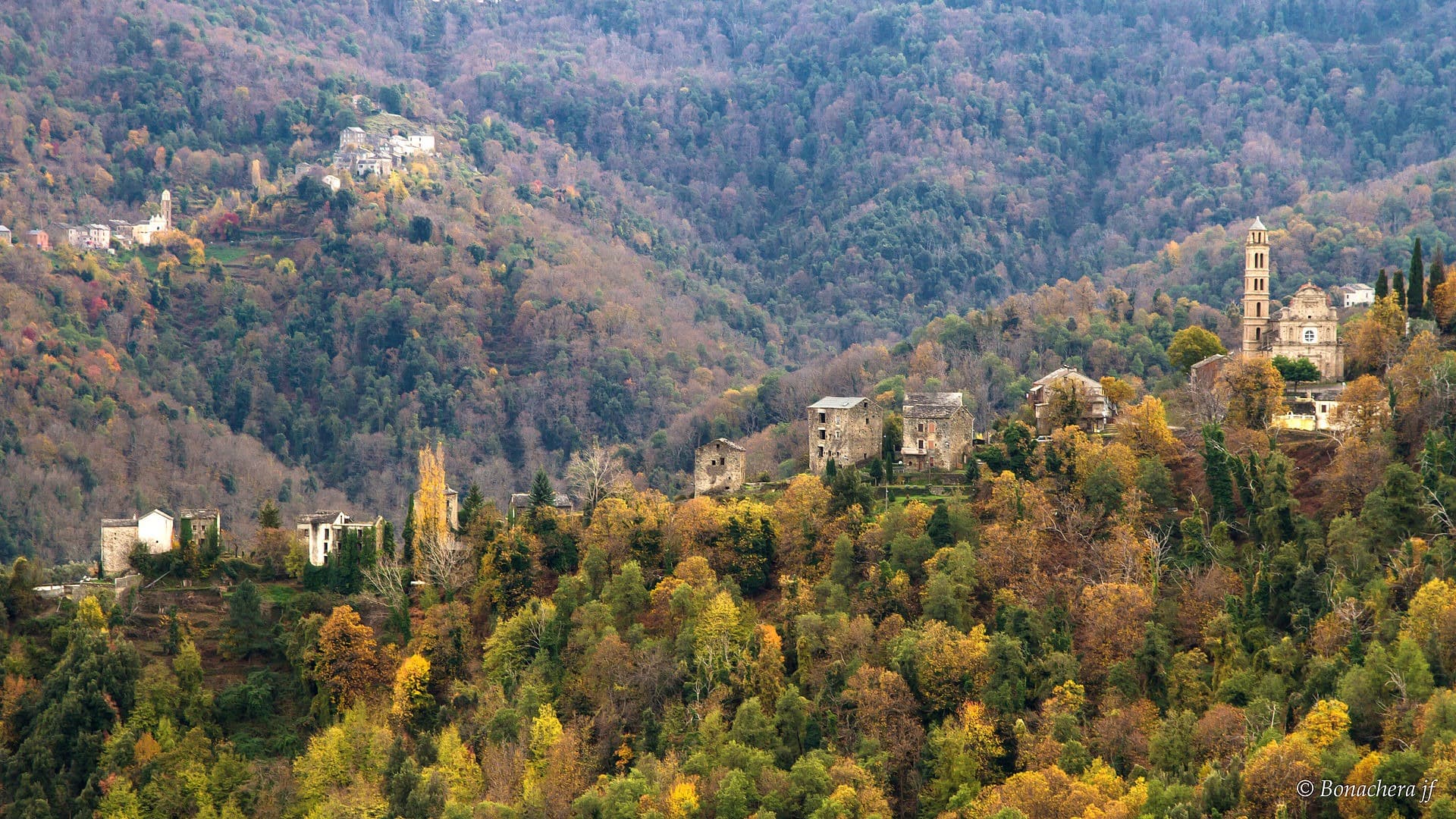
The hinterland shifts radically in atmosphere. Thirty minutes from the coast, Castagniccia unfolds its dark schist villages—La Porta, Piedicroce, Morosaglia, birthplace of Pascal Paoli—on ridges covered with chestnut trees. The chestnut sustained Corse for centuries: its AOP flour is still produced today, used for pulenda, traditional Corsican polenta, and fritters. Further south, Fium'Orbo and Bozio offer perched villages, seldom-visited Romanesque chapels and modest hiking trails. This combination of coastal plain plus immediate mountains to the west makes the region's principal appeal for a mixed stay.
On the dining side, you'll find the territory's agriculture: nustrale pork charcuterie in mountain villages, fresh brocciu according to season, Diana oysters, white vermentinu and red niellucciu wines. Summer patron saint festivals—A Fiera di u Casgiu in Venaco in May, A Fiera di a Castagna in Bocognano in December—allow you to meet producers outside peak tourist season.
To discover
Aleria archaeological site. The Roman forum, thermal baths and the Carcopino museum housed in the fort of Matra trace 600 years of Phocaean and then Roman occupation, with Attic and Etruscan ceramics rarely assembled elsewhere in the western Mediterranean.
Diane and Urbino lagoons. Oyster and mussel tasting directly from oyster farmers, at the lagoon's edge, with a glass of vermentinu from the plain. Expect around twenty euros per dozen, open year-round.
Castagniccia villages. La Porta, Piedicroce, Morosaglia: tall dark schist houses, baroque bell towers and chestnut forests at 800 metres altitude, 30 minutes' drive from the coast.
Biguglia nature reserve. Corse's largest lagoon, 1,450 hectares just south of Bastia, where pink flamingos are observed during migration and ospreys fishing from observation posts arranged around the water.
IGP clementine orchards. Between Linguizzetta and Ghisonaccia, orchards can be visited during harvest, from mid-November to February, at several producers who explain cultivation and offer fruit tastings—those with two leaves.
When to visit
The eastern plain is Corse's driest and hottest zone. From May to mid-October, daytime temperatures range between 22 and 32 °C, with the sea at 24-26 °C in July-August. July and August are hot, sometimes oppressive in the absence of westerly winds, with sustained crowds on the beaches of Pinia and Pinarello. We recommend May-June and September-early October for swimming, archaeological visits and hinterland hiking in more stable conditions. Clementine harvest, from November to February, also justifies an off-season stay: daytime temperatures of 12-16 °C, moderate rainfall, hotels open in Aleria and Ghisonaccia.
In Castagniccia, expect 5 to 8 °C cooler than the coast. October and November there are remarkable for the colours of the chestnut forests, but morning fog is frequent. In winter, passes can be briefly snow-covered above 1,000 metres.
Practical advice
We recommend 3 to 4 days on the eastern plain within a Corsican itinerary of 10 to 14 days: one day for Aleria and the lagoons, one day in Castagniccia, one to two days of beaches. The region is reached in 40 minutes from Bastia-Poretta airport, which is also the logical entry point. The RT 10 (ex-N198) runs the length of the plain from north to south and allows you to reach Solenzara in 1h30, gateway to the far south.
The most coherent combination is with Cap Corse and Balagne to the north, accessible from Bastia, or with the far south and Bonifacio by continuing the coast towards Porto-Vecchio. To connect the west coast and Ajaccio, you must cross the mountainous centre via the Vizzavona or Vergio pass, allow 2h30 to 3 hours of driving. Accommodation is family-oriented, in beach residences at Ghisonaccia or Linguizzetta, in guesthouses in Castagniccia villages. The region suits families with young children for its shallow beaches, and travellers interested in archaeology, gastronomy and rural heritage. Serious hikers will prefer the mountainous centre or Bavella.