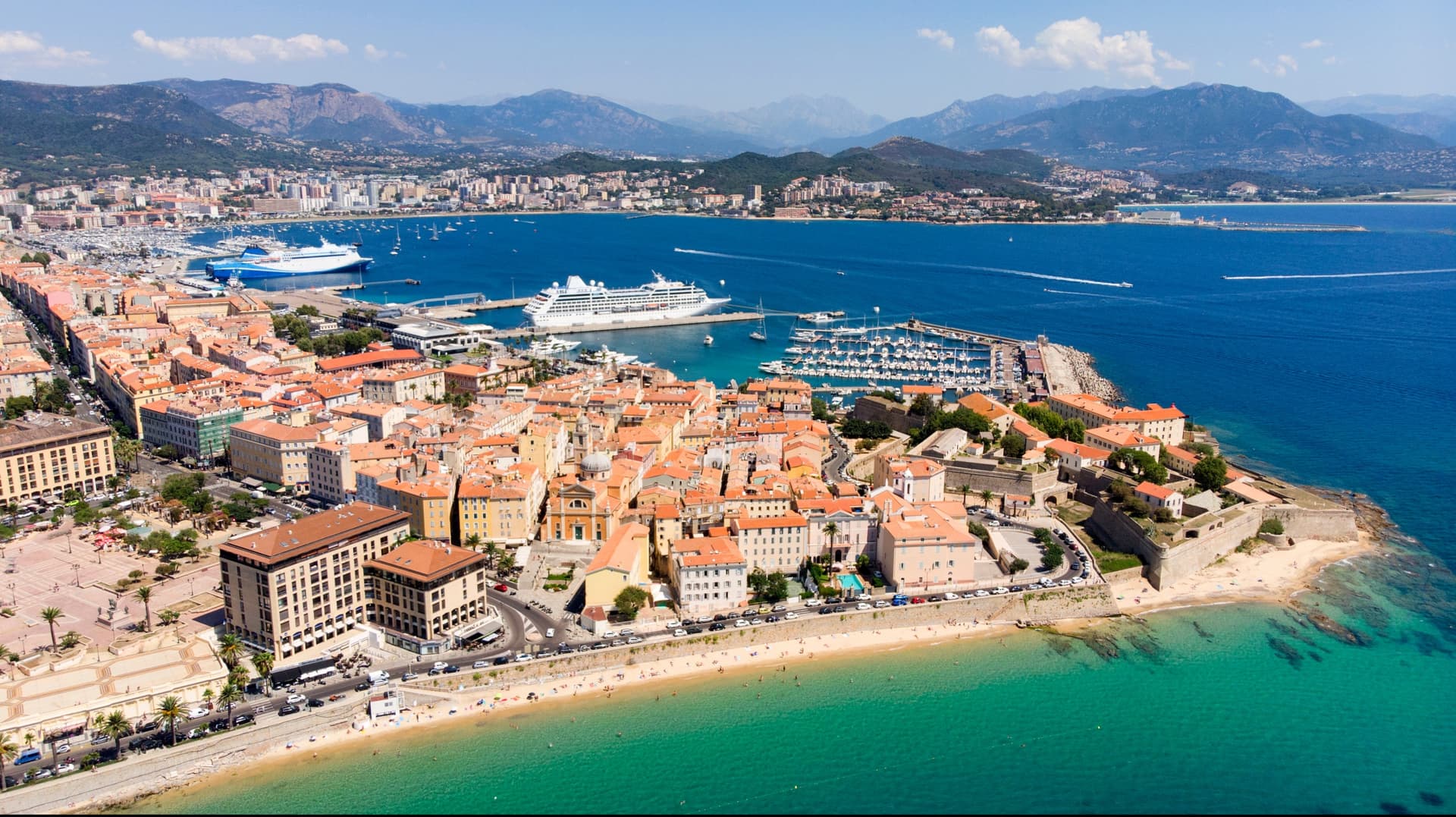
West Coast and Ajaccio
From the Bay of Ajaccio to the red cliffs of Piana and the volcanic Scandola Reserve, a coastline sculpted by granite and accessible from the island's main airport.
Corsica's west coast stretches nearly 200 kilometers between the Gulf of Ajaccio and the Gulf of Calvi, shaped by a succession of deep bays, granite peninsulas, and red rhyolite cliffs. It is here, in the Bay of Ajaccio, that our agency has its home port: the city is home to 70,000 residents, an international airport (Napoléon Bonaparte), and concentrates most of the maritime connections to mainland France. From the Quartier des Étrangers or Place Foch, the covered market is just a few minutes away, where fresh brocciu, coppa from Cuscionu, and figatelli from the hinterland are sold.
North of Ajaccio, the D81 road climbs toward Cargèse, a village founded in the 17th century by Greek families from the Magne fleeing the Ottoman Empire. The two churches facing each other, one Latin Catholic and the other Greek Catholic, still testify to this dual identity. Further on, Piana marks the entrance to the Calanches, these red granite formations sculpted by erosion, listed since 1983 on UNESCO's World Heritage list as part of the Gulf of Porto. The boulders take on their most intense hue an hour before sunset; the road, carved into the cliff face, is in places only 3.5 meters wide and demands careful driving.
The Gulf of Porto marks the junction with the Scandola Natural Reserve, created in 1975 and also UNESCO-listed. The volcanic peninsula is accessible neither by car nor by swimming: only boats operating from Porto, Cargèse, or Galéria can trace its coastline, and landing is forbidden. Between Scandola and the hamlet of Girolata, you can take the mule track from the Col de la Croix, a two-hour round-trip walk through fragrant maquis terrain (myrtle, rock rose, everlasting). Girolata, with around twenty year-round residents, is connected to no road: supplies by boat, solar electricity, school closed long ago.
The Ajaccio hinterland opens onto the Liamone and Taravo, two cereal-growing valleys where perched villages like Sari-d'Orcino and Zicavo still stand. Summer transhumance to the Cuscionu alpine pasture at 1,500 meters is still practiced by a few shepherds who produce bruccatu and sheep tomme aged in caves. It is also in this zone, at Sainte-Marie-Sicché and Bocognano, that you find chestnut flour pulendi and Corsican soups served in winter.
On the sea side, the waters of the Gulf of Ajaccio reach 22 to 24°C from June to September, cooler in the Gulf of Porto where deep-water upwellings often maintain 19 to 21°C in July. Beaches vary within just a few kilometers: fine sand at Capo di Feno and Ruppione, pebbles at Bussaglia, red-rock coves at Ficaghjola. Artisanal fishing still supplies several Ajaccio restaurants with sea bream, pageots, and spiny lobster, and the fish market at Port Tino Rossi remains active early in the morning.
Ajaccio, the birthplace of Napoléon Bonaparte in 1769, preserves the family home on Rue Saint-Charles, the Fesch Museum (France's second-largest Italian collection after the Louvre), and the baroque cathedral where the emperor was baptized. The Napoleonic celebrations of August 15 gather costumed reenactments and a mass at the imperial chapel. For many travelers, it is the first point of contact with the island, and an entry point that our English-speaking team considers logical for exploring northward and toward the center.
Must-See
The Calanches of Piana at twilight. Red rhyolite rocks sculpted into needles and tafoni, to be explored slowly over the 10 km of the D81 between Piana and Porto. Light falls just before sunset, around 8 p.m. in July.
Scandola and Girolata by sea. A 3 to 4-hour boat trip from Porto to trace the volcanic reserve, spot osprey nesting on the cliffs, and land at Girolata, a roadless hamlet accessible only by sea or mule track.
Ajaccio market at Place Foch. Every morning except Monday, stalls of brocciu, Cuscionu charcuterie, maquis honey, and Corsican clementines in winter. This is also where our English-speaking team stocks up before mountain picnics.
Cargèse, Greek heritage. Two churches facing each other, one Latin Catholic and the other Greek Catholic, testament to the Maniote families settled in the 17th century. The Sunday morning Orthodox mass is still sung partly in Greek.
Cuscionu bergerie in summer. At 1,500 meters altitude, a summer pasture plateau accessible from Zicavo by a 12 km track. A few shepherds bring their sheep from June to September and still make bruccatu on-site.
When to Visit
The most balanced season runs from mid-May to mid-June and from mid-September to mid-October: daytime temperatures of 22 to 27°C, sea between 19 and 22°C, coastal trails still flowering in spring and soft light in autumn. July and August reach 30 to 33°C in Ajaccio, sometimes 35°C in the hinterland, with heavy traffic on the D81 between Piana and Porto; boats to Scandola should be booked several days in advance. Water peaks at 24°C in August, ideal for swimming but not conducive to hiking at midday.
From November to March, the coast remains accessible with 12 to 16°C daytime temperatures, but many seafront hotels and restaurants close between November and March. Rain concentrates in November and December (sometimes 150 mm monthly in Ajaccio) and mountain roads leading to Cuscionu or Col de Vergio may be snow-covered from December to April. Our English-speaking team recommends avoiding the first half of August if you seek tranquility.
Practical Advice
Plan a minimum of 4 to 5 days to explore the region without rushing: one day in Ajaccio and its surroundings, two days between Piana, Porto, and Scandola, and one or two days in the Liamone or Taravo hinterland. Ajaccio's Napoléon Bonaparte airport and the commercial port are the most direct entry points; from mainland France, the sea crossing from Marseille, Toulon, or Nice takes 6 to 12 hours depending on the route. Between Ajaccio and Porto, the winding road takes about 2 hours for 85 km, and night driving on the corniche is not recommended.
The west coast naturally combines with the Balagne and Cape Corse to the north (Calvi is 2.5 hours from Porto via the D81), or with the mountainous center via Col de Vergio (1,477 m) and Aïtone Forest. For a first visit, our English-speaking team often proposes a west coast + far south + mountainous center itinerary over 12 to 15 days. The region suits contemplative travelers and hikers well; families with young children will prefer the beaches of the Gulf of Ajaccio (Ruppione, Verghia) to the steep coves of the Gulf of Porto. Lodging ranges from rural stone cottages in Ota or Évisa to character guesthouses in Ajaccio's old town.