Carcheto
Carcheto
Nestled at 2,067 feet in Castagniccia, Carcheto-Brustico brings together baroque heritage, 15th-century tower houses, an emerald waterfall, and marble once prized by the Medici.
Tired of skyscrapers, highways, subway noise, and the chaos of major cities? Escape to Upper Corsica, heading toward Castagniccia, to Carcheto-Brustico, where the majority of buildings date from the 15th to 19th centuries. For an authentic change of pace, this French village offers an extraordinary setting thanks to its charming tower houses that transport you on a fascinating journey through time. Its natural heritage awaits discovery through hiking trails that will enrich your Corsican getaway.
Carcheto-Brustico, Where Time Stands Still
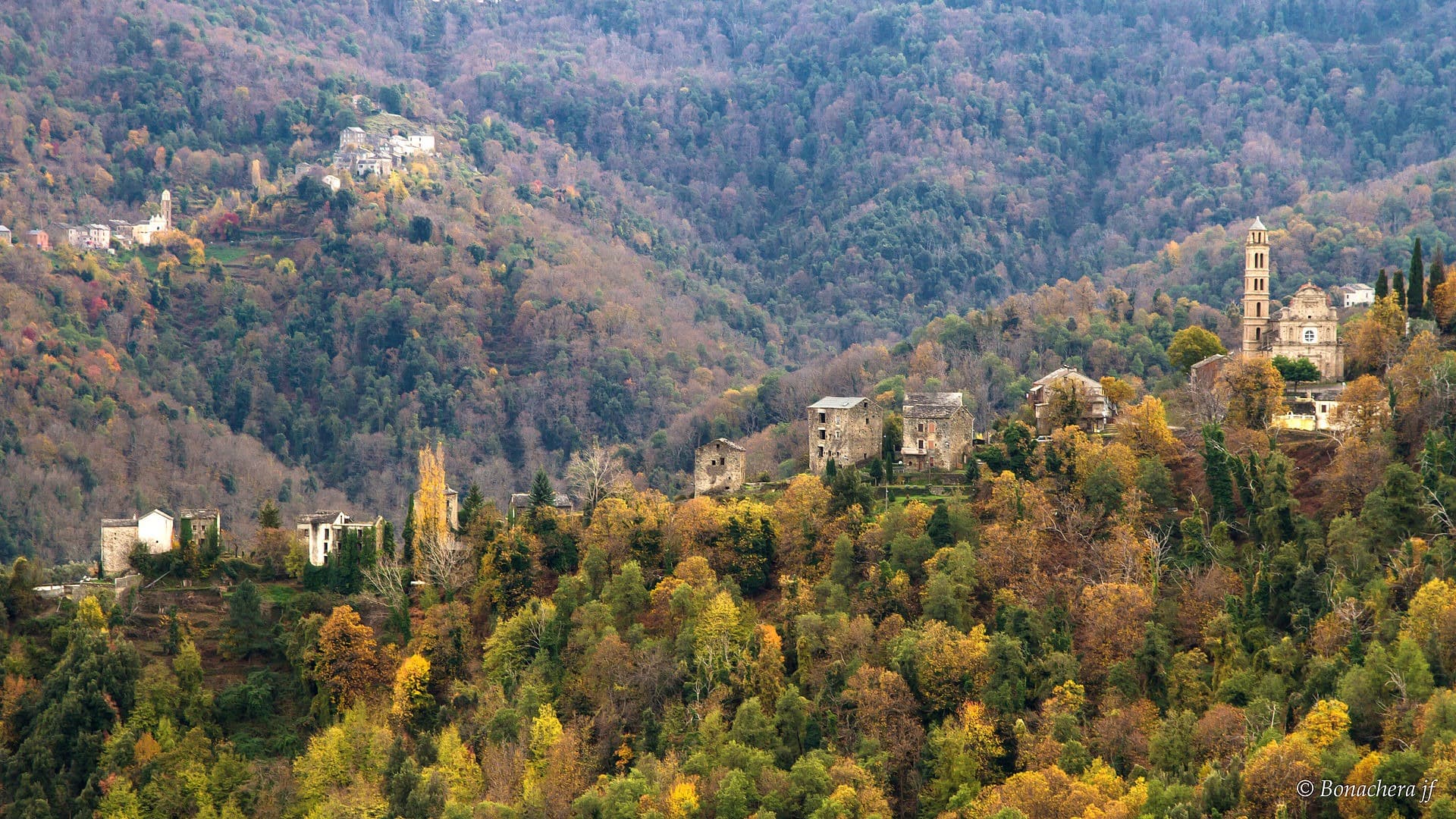
Perched at 2,067 feet above sea level, the commune of Carcheto-Brustico was born from the merger of two villages, Carcheto and Brustico, which united on January 1, 1972. Spanning 5.19 square kilometers, it comprises three settlements: Carcheto, Brustico, and the hamlet of Colle set slightly apart. According to the 2017 census, this village in the Orezza piève numbers just 31 residents.
Carcheto-Brustico stands out for its impressively tall buildings. The village offers a striking display of tower houses and represents the finest expression of traditional Castagniccia architecture. Ninety percent of its buildings date from the 15th to 19th centuries. What's more, these homes are beautifully surrounded by chestnut forests that explode with brilliant color in autumn. Combined with nearby waterfalls, this destination truly merits a detour during a Corsican journey.
Echoes of the Past
The Tevola Towers were tower houses forming a collection of rural lodgings built at the initiative of the Countess Tevola. They provide a traditional backdrop to the villages of Castagniccia. One of these towers still stands at the heart of Carcheto-Brustico. Local legend tells of this place being the hideout of a notorious bandit from the 19th century named François-Marie Castelli. He terrorized the village and surrounding areas, threatening, persecuting, and coldly executing inhabitants on the slightest suspicion of opposition. After numerous murders, the bandit was shot in the back. As for his assassin-avenger, their identity remains unknown…
What to See in Carcheto?
Historical and Cultural Heritage
Nestled in the hamlet of Carchetu, the Church of Sainte Marguerite captivates visitors with its baroque style. Designated a Historic Monument in 1976, it houses numerous religious artworks and objects. Its crowning jewel is its "magnificent tabernacle architecturally designed with 8 columns, carved wood, molded, polychrome-painted and gilded." Take note also of the organ case in spruce, the main altar and six other altars, but especially the mural painting depicting Saint Margaret in glory, surrounded by angels.
Situated in the hamlet of Brustico, isolated amid nature, the Church of Saint Joseph presents a striking contrast between its ornate baroque facade and the building's body, made of ashlar stone and far more massive. It dates from the early 18th century. Its substantial religious heritage deserves your attention.
The Chapel of San Bastianu sits at the bottom of the village, on the path leading to the Struccia waterfall, within the rural lodgings of the Tevola Towers. It is currently undergoing restoration.
The Chapel of San Martinu, located on the path to the former Vert d'Orezza mine, likely dates to the Middle Ages and is currently in ruins. To its right stands a potable water fountain of the same name.
As you can see, Carcheto-Brustico brims with historical and religious monuments. The Chapel of Saint Roch opposite the town hall and the Chapel of San Marcello, now serving as a cemetery, round out the list. Make the most of your stay in Carcheto-Brustico by exploring its natural heritage.
Natural Treasures
The magnificent "Struccia" waterfall encompasses other compelling natural sites to discover during a walk through the forest below Carcheto-Brustico village. Its 49-foot cascade plunges between stone cliff walls to fall into emerald waters. Accessible from the baroque Church of Sainte Marguerite's square by turning left, the waterfall is preceded by a covered fountain called "Funtana di l'Onda" a short walk away. There's also the Gradi Fountain located roadside heading toward the Arcarota pass.
It's also during your visit to Carcheto-Brustico that you'll encounter the rarest and most expensive marble in the world. This is the former "Vert d'Orezza" quarry, called "Verde di Corsica" or "Verde antico di Corsica" in Italy. Counted among "one of Corsica's most celebrated mineralogical treasures from antiquity," this site has been worked from prehistoric times to the present day. The famous Medici mausoleum in Florence stands as compelling proof of its historical use. Today, Corsican artisan jewelers continue to mine it.
What to Do in Carcheto?
Beyond visiting Carcheto's tourist monuments, you can enhance your stay in Carcheto-Brustico with hiking in the surrounding area. We suggest three trails of varying difficulty: easy, moderate, and challenging.
- Start from Santa-Maria-Poggio to discover the Ucelluline waterfall (the little bird in Corsica) on the path leading to San Nicolao. Spanning 4.7 miles, the hike takes about 3 hours 25 minutes. You'll be rewarded with a fabulous natural spectacle from this wild, unspoiled site where fresh, clear water cascades before your eyes. The elevation gain (ascent/descent) is around 1,300 feet.
- To visit Porri Grotto, you'll take a moderately difficult hiking trail of 2.4 miles from the village of Porri with an elevation gain of 970 feet. This grotto, known as the "Maquis Fighters' Grotto," served as a refuge and/or headquarters for the island's Resistance.
- For the experienced and intrepid, tackle more demanding trails such as those leading to Pianellu Waterfall and Punta di Caldane. At the exit of Pianello village on the D16, on the road to Matra, just past the bridge lies the Pianellu Waterfall, a magnificent oasis of refreshment. Continuing the hike, you'll pass the forgotten hamlet of Saint-Vincent and its chapel, then shepherds' lodges before reaching Punta di Caldane, where the sea views are simply breathtaking.
Make the most of your stay in Carcheto-Brustico by exploring the village's sites of interest and its surroundings. Cultural, historical, and natural sites plus other tourism treasures will enhance your Corsican vacation.
Want to discover this destination?
Our local advisors design your tailor-made trip.