Lunghignano Oil Mill
Lunghignano Oil Mill
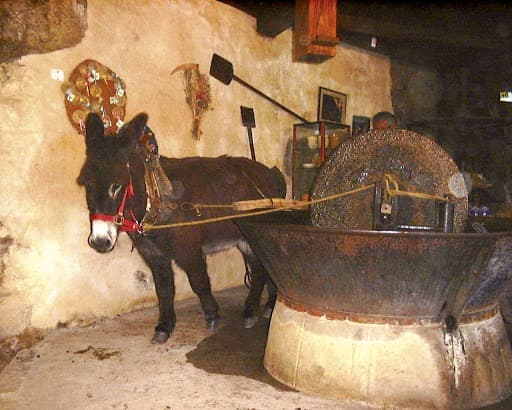
U Fragnu, in Lunghignano, is an artisanal oil mill in Balagne housed in an 1815 building, where the millstone is still pulled by a donkey during harvest season.
The U Fragnu oil mill, in Lunghignano, is an artisanal olive oil operation housed in an 1815 building in the heart of Balagne. Its name means "the press" in Corsican. The vertical millstone is still pulled by Georges, the house donkey, who works for two and a half months every two years at harvest time. The visit combines technical heritage, olive oil tasting and local products, and a stroll through a mountain village that has remained off the beaten tourist path.
Why visit the Lunghignano mill
U Fragnu is not a reconstructed museum: it is a seasonally active mill where a vertical millstone, three presses and a settling basin still produce oil using traditional methods. The visit takes place in a building over two centuries old, which houses both a wooden endless screw press over 300 years old and a second press inherited from the industrial era. Together, they provide a concrete picture of the evolution of oil-pressing techniques in Corsica.
The site also serves another purpose: it acts as a gateway to the village of Lunghignano, perched on a mountainside, and to the surrounding chestnut-growing landscape—roughly 150 hectares of chestnut trees visible around the town, testament to Balagne's agricultural past.
History of the mill and village
The building that houses U Fragnu dates from 1815, and the wooden endless screw press it preserves is even older, with over three centuries of use. The mill has gone through several phases: traditional animal-powered milling, then the addition of an industrial press, followed by renovation efforts led in particular by the local municipality. The current establishment, in its family-run and publicly open form, was taken over in the 20th century by the Bernardi-Roy family (Jean-François Bernardi and Marie-Dominique Roy), who ensure its operation and activities.
The village itself is worth a detour. On the eastern heights, remnants survive of the Pilone fort and an old medieval village abandoned in the 17th century. Lower down, an 18th-century baroque church stands out for its richly carved doors, much like several old houses in the town.
What to see and do
The mill in operation
Inside the building, the vertical millstone, three presses and the settling basin are visible in their working configuration. A short film explains the olive oil production process, which is useful since the harvest falls outside the main tourist season: most summer visitors do not see the millstone in action.
Georges, the house donkey
Animal power is a reality here, not mere decoration. Georges pulls the millstone for two and a half months every two years at harvest time. Outside this period, he lives on site and is part of the visit.
Tastings and shop
The establishment offers tastings of olive oils produced on site as well as oils from other producers. The shop sells local products: oils, honey, tapenades, jams, myrtle liqueur, limoncello. It's an opportunity to compare different Corsican oil profiles without sales pressure.
Wandering through the village
Lunghignano is best explored on foot. Plan for a loop walk of around an hour to see the baroque church, the carved doors of old houses, and climb to the eastern heights where you can glimpse the ruins of the Pilone fort and medieval village.
Practical information
The mill can be visited freely in its shop and tasting areas; guided tours are typically provided by the owners. The visit, including the film, takes approximately 45 minutes to 1 hour, plus time spent exploring the village. Moderate admission fees; bring cash, as network coverage is limited in the area.
When to visit
U Fragnu is open from April to late October. To see the mill in operation, aim for late season (October) or contact them directly, as harvest only occurs every two years and remains weather-dependent. Spring and early autumn offer the most pleasant visiting conditions: mild temperatures, clear light on the chestnut groves, and moderate crowds. In July-August, the establishment is open continuously but the mill is not operating.
How to get there
Lunghignano is a mid-mountain village in Balagne, in the hinterland of Calvi and Île-Rousse. Access is by car along narrow, winding roads; there is no practical public transport to reach it. From Calvi, allow around 30 minutes of driving; from Île-Rousse, slightly less. Parking is limited at the village entrance: it's advisable to arrive early during high season.
Nearby attractions
Balagne lends itself to a loop itinerary connecting several perched villages (Sant'Antonino, Pigna, Corbara) between Calvi and Île-Rousse. To further explore inland and coastal Corsica, several sites complement a visit to Lunghignano well:
- The San Rinieru romanesque chapel, a testament to the island's ancient religious heritage.
- The Ospédale forest, for an immersion in Corsican mountains.
- The Tamarone beach, in Cap Corse, for a wilder seaside stop.
Frequently asked questions
Frequently asked questions
Plan your trip
U Fragnu fits naturally into a Balagne circuit blending perched villages, religious heritage and coastline. To build a tailor-made itinerary incorporating this oil mill stop, consult our Corsica trips.
Interested in this visit?
We can include it in your personalised itinerary.